I spent last week at the Sustainable Finance Summit and the events orbiting Canada Climate Week Xchange in Toronto, and one theme stood out above all else: the conversation has moved on.
Read this full original article on LinkedIn.
ESG wasn’t the headline, and emissions weren’t a top priority. Instead, the room was locked in on something far more urgent and material for everyone: physical climate risk and the ability for households to afford mitigation solutions. Emissions reductions have always been the real long-term solution; they’re just far harder to attribute and therefore easier to delay.
But the bill always comes due. We knew the impacts were coming, and now they’re here, and they’re far more expensive to manage. It’s the difference between taking out a 4% loan to fix your roof now, versus putting a major flood on your credit card at 21% interest and making minimum payments forever.
That’s where we are with climate resilience: we skipped the cheap prevention, and now we’re paying credit card rates for climate disasters. The age of “priced-in” climate risk is here, and lenders will pass the price onto consumers.
From major pension funds to the largest chartered banks, the message during Canada Climate Week Xchange was blunt: homes are getting more expensive to insure, more costly to maintain, and more exposed to disruption from climate events.
And that’s a story that hits everyone where it hurts.
Here are my four key takeaways from the week:
Read this full original article on LinkedIn.
Storms, fires, and flooding aren’t “future concerns.” The Federal Reserve Board shared that in the last 12 months alone, climate-related losses approached $80B, and the pattern is now “everywhere, all the time.” Investors and regulators are pushing banks and insurers to build resiliency frameworks that can keep pace with a rapidly shifting environment.
Financial strain on homeowners (especially those in older, under-insured, or high-cost properties) came up in every room at the Sustainable Finance Summit. Lenders are increasingly concerned about the secondary risk of households stretched thin by rising operating and repair costs.
My favorite moment of the Summit was a dramatic revelation from the speaker from OSFI. In a catastrophic climate-related, event, Canada could face substantial losses in residential assets with non-insured or underinsured assets. Banks are being urged to price in that risk, meaning that the need to hold more cash in reserve will eventually be reflected in mortgage costs. But the missing link is the same everywhere: banks can model risk, but they can’t act without building-level insights.
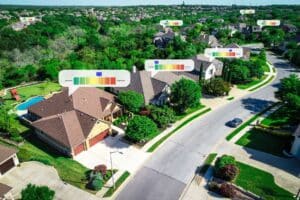
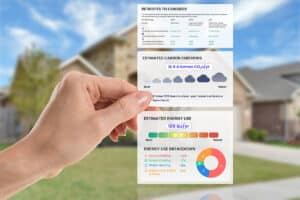
This is exactly where climate-aware lending and high-quality property data have become essential. As Climative’s work with banks and governments shows, lenders need building-level visibility into energy use, resilience measures, and upgrade paths to manage risk/exposure and to support homeowners through targeted programs and financing.
And unlike years past, the industry now recognizes that this isn’t about “selling sustainability.” It’s about keeping homes safe, re-risking portfolios, and unlocking practical upgrade pathways that improve comfort and safety while strengthening affordability. Climate-aware lending is increasingly understood as a self-funding growth engine rather than a cost center.
With banks distancing themselves from politicized climate narratives and focusing on near-term financial risk, policymakers now play a critical role in enabling access to the foundational data that enables building-level risk assessment. This access gap is a major barrier identified across multiple Climative projects with financial institutions.
Where we go from here:
For anyone building financial products or shaping policy in the U.S. or Canada, the direction is clear:
This shift isn’t all that surprising. The sad reality is that we’ve largely moved from climate mitigation to climate adaptation, and it’s clear to anyone who’s following the money. The good news is that it grounds the climate conversation in what matters most to homeowners AND lenders: safety, cost, and resilience. And it opens the door to practical solutions that scale, exactly the space where digital platforms like Climative and climate-aware lending can have the greatest impact.
If you were at the Summit and CCWX in Toronto and want to compare notes (or if you’re working on products or policy that touch housing, resilience, or climate-related risk) I’d love to connect.

Winston has 25 years experience as a leader in the telecommunications and utility industries. His in-depth knowledge of energy analysis and large-scale web-based platform deployments informs Climative's strategy in his role as CEO.



Climative provides a collaborative AI-assisted data platform for organizations to enable personalized advice and offers to building owners, taking the guesswork out of building upgrades and transforming the low carbon economy.
We use cookies and other tracking technology to understand how visitors use our site and to improve your experience. By continuing to use our site, you consent to our use of cookies. Learn more in our Privacy Policy.