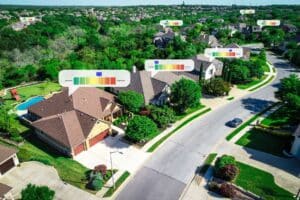
The era of climate change prevention is fading; we’re in adaptation mode. Financial institutions that don’t consider climate resilience in their mortgage portfolios expose themselves to substantial risk. Nearly a trillion dollars in capital is required to manage the climate transition for buildings, which brings new lending and customer engagement opportunities.
When financial institutions have better building-level data about a home’s climate risk and retrofit potential, they can position themselves as a partner to help customers achieve the home they want:
By incorporating personalized home upgrade advice into their digital customer journey, financial institutions can be the source of both knowledge and capital for this critical financial decision. A large number of upgraded homes re-risks the overall mortgage portfolio by reducing physical climate risk, stabilizing property values, and reducing payment disruptions.
Let’s talk about this as a simple 4-pillar cycle:

It’s more than just steps to a more resilient portfolio. Each pillar brings robust benefits for banks, homeowners, and the planet and sets the stage for continued intelligent adaptation. Let’s dive in.
You can’t improve what you can’t measure. High-quality building-level climate data supports a real-time, strategic approach to decarbonization and climate risk management. As demonstrated in a case study with a top-10 North American bank and others, Climative has achieved scalable, affordable access to high-quality building-level climate data that is PCAF-accredited.
But that’s just the beginning. Let’s discuss what really matters: ACTION. A strong data foundation enables actionable insights and tracking climate transition progress.
Here’s how.
Whether your goal is decarbonization, climate risk reduction, or both, it’s important to establish a starting point at the portfolio level. This enables more accurate emissions reporting, an understanding of overall climate risk, and a baseline for measuring progress toward climate goals.
The true power of the data is unlocked when emissions, energy use, and building characteristics are combined with demographics and customer data. Here are some creative ways to segment a mortgage portfolio:

A major challenge for monitoring emissions reduction progress is understanding the source of the reduction: Is it retrofit action? A change in the grid’s fuel source? Major climate fluctuations? Climative’s Automated Carbon Model (ACM™) enables an analysis that isolates retrofit action: track energy use directly (not emissions), as it’s not impacted by changing emissions factors. This allows financial institutions to track the impact of retrofit activities on total portfolio emissions, allowing them to refine their offers, marketing, and customer engagement.
People want a home that is cost-effective, climate-resilient, and comfortable.. Meanwhile, many homeowners are either intimidated or disengaged from the idea of upgrading their homes. The leading demotivating barriers are a lack of knowledge of what to upgrade, and a lack of capital to make it happen. Banks who integrate home upgrade advice in the digital customer journey can position themselves to address both of these barriers, thus improving customer relationships and creating new loan opportunities.
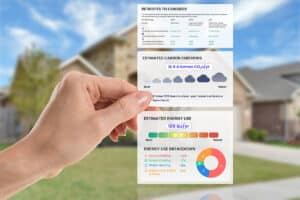
The building-level data discussed in Pillar 1 is the foundation for Personalized Home Upgrade Plans – user-friendly information about one’s home, complete with configurable upgrade advice. The goal of the Plan is to make home upgrades less intimidating, thus moving homeowners through the Customer Journey toward making an investment.

It’s known that homeowners are more likely to move to the next step of the home upgrade journey when they’re armed with useful information about their home. Once homeowners are engaged with their Upgrade Plan, they can customize the recommendations to their priorities (affordability, comfort, safety, emissions, and more) and the decision-making criteria to make it happen.

Once homeowners have viewed their Home Upgrade Plan, personalized their priorities in the interface, reviewed their options, and understood the impact on their finances, they are further along in the Customer Journey and approaching a Decision to invest. Financial institutions should position themselves as a supporting resource at this stage.
Financial institutions who have wisely tied their digital customer experience to a Personalized Home Upgrade Plan can position themselves as the partner to make their customers’ home upgrade dreams come true. Embed offers such as:
By integrating Personalized Home Upgrade Plans within the digital customer experience, financial institutions can drive more users to bottom-of-the-funnel conversions on big-ticket loan items at key decision points. Mortgage renewal, refinancing, and even changes to insurance coverage or premiums are ideal opportunities to make homeowners aware of options to upgrade their homes to be more resilient, safe, and affordable to operate.
Financial institutions successfully executing Pillars 1 through 3 are armed with better building-level climate data, more informed customers, and increased uptake of home upgrade loans. At a portfolio level, this translates into thousands or millions of upgraded homes that are more affordable to operate, safer to the physical impacts of climate change, and more comfortable in the face of fluctuating weather. What does it mean for a mortgage portfolio to be full of upgraded and resilient homes?
It means reduced risk:
Finally, the climate-aware portfolio creates the next baseline of the building stock, arming homeowners and financial institutions with the tools to respond proactively to the evolving climate situation.
The climate-aware portfolio creates the next baseline of the building stock, arming homeowners and financial institutions with the tools to respond proactively to the evolving climate situation.
Climate-aware lending represents more than a sustainability initiative. It’s a strategic, self-funding growth engine that strengthens customer relationships, creates lending opportunities, and builds a more resilient mortgage portfolio.
Each pillar in this cycle reinforces the next: data drives insight, insight drives engagement, engagement drives loan uptake, and loan uptake drives portfolio resilience. The result is a positive feedback loop for climate adaptation that benefits everyone:
Climative offers an end-to-end platform solution to financial institutions ready to seize the profitable opportunity of climate-aware lending. Leverage our PCAF-accredited building-level climate data for deep insights, then intelligently engage homeowners with Navigator.
Click here to book a demo or click here to contact our team.

As Climative's VP of Product, Ian drives product strategy, focusing on customer needs and strong product-market fit. He's an entrepreneurial leader who loves paddling his homemade canoe.



Climative provides a collaborative AI-assisted data platform for organizations to enable personalized advice and offers to building owners, taking the guesswork out of building upgrades and transforming the low carbon economy.
We use cookies and other tracking technology to understand how visitors use our site and to improve your experience. By continuing to use our site, you consent to our use of cookies. Learn more in our Privacy Policy.